

Where did ordinary people get information and learn about the main events at the beginning of the 20th century? Newspapers were the answer. At that time, until the advent of the Internet, the average resident only learnt about social and political life from periodicals. Newspapers and magazines replaced Wikipedia, social networks and the Internet. Houston, as one of the largest American cities, has its own long and interesting history of periodicals, which did not sink into oblivion even in the electronic era and the time of the Internet. They continue to inform residents about various events. We collected a list of such publications and the history of their creation below. Read more on houston1.one.
The Houston Telegraph: the first experience, a short existence and a role model
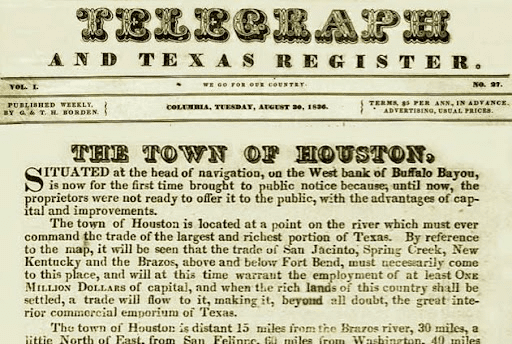
Over the years of Houston’s existence, the city has had many print media that emerged and suddenly disappeared. They were, as a rule, small in format and circulation and were often devoted to local news and politics. The first newspapers appeared almost immediately after the founding of the city. However, the very first in the middle of the 19th century was the Houston Telegraph. On August 5, 1839, the first copy of this newspaper was published. It was a weekly, published on 8 pages. In addition to news and political reviews, it placed advertisements. The founders were local businessmen who decided that an increasingly large city needed its own media. Without wasting time, the staff was selected from among local residents and the Houston Telegraph went to the masses. There was neither financial nor technical ability to allow large circulations and the newspaper sold very quickly. In addition, it was published only once a week.
The content of the newspaper covered not only Houston but also told about news, political events and cultural life of Texas. If we take the historical context and the time frame of the newspaper’s existence, Texas was on the verge of change: to remain a sovereign Republic or become part of the United States. Judging by the content, the owners or reporters actively supported the second option, namely the annexation of the Lone Star State by the United States. This is clearly visible on the pages of the surviving copies.
During the Civil War, the Houston Telegraph supported the Confederacy. This is not surprising, as the majority of southerners held the same opinion. The newspaper reflected the mood of the majority of Houstonians, retaining its supporters-readers.
Over time, new publications began to appear. It became increasingly difficult to compete. Therefore, at the end of the 19th century, the Houston Telegraph was forced to merge with other publications. This was a typical practice for that time. Competition, financial difficulties and changing political circumstances allowed only the strongest to survive. Although the Houston Telegraph existed for only a few decades, it entered the history of the region as the first printed media, set the tone and laid the foundation for all subsequent publications.
The Houston Chronicle: fantastic start-up capital, dangerous criticism of the Ku Klux Klan and state recognition
In 1901, the first issue of the Houston Chronicle newspaper was published in Houston. It was a landmark event. After all, the publication has been and remains a leader. However, this was preceded by an incredible story about luck, risk and the realization of dreams. Let’s discover more details.
A young reporter named Marcellus Elliot Foster worked for the popular Houston Post newspaper and had ambitious plans. The young man dreamed of creating his own publication. However, this was completely unfeasible with his salary. Once, he received an assignment from the editorial office to cover the event of the discovery of an oil well in Spindletop. Foster went to the drilling site. When he got into the subject, he realized that fate was giving him a chance. He bought an option on a well for future drilling with all the money he had – $30, which was his monthly salary. A week later, he sold his share and received $5,000, which was a fantastic amount at that time.
Foster returned to Houston with a lot of money and the knowledge of what he would spend it on. Even this amount was not enough to realize his dream. Thus, he persuaded his friends and colleagues to an unheard-of adventure. The young man had a remarkable talent for persuasion. In a short time, he managed to attract another $20,000 in investment. On October 14, 1901, the Houston Chronicle was founded in a shabby three-story building on Texas Avenue in downtown Houston.
The first copies were published in a circulation of 4,378 copies and sold for 2 cents. This was quite ambitious. At that time, there were only a little more than 45,000 residents in Houston. However, the newspaper appealed to the locals. Within three years, the circulation had increased several times. The publication was gaining the attention of the townspeople despite the growth of the number of printed media. In 1904, Foster and his company established a weekly publication that had as many as 44 pages. In addition to the usual news, reviews, political topics and advertising, the Houston Chronicle began to print 4-page color comics.
In a short period of existence, the newspaper could no longer fit in the small building. Therefore, Foster, as an experienced manager, entered into an agreement with an equally ambitious young developer. As a result of the agreement, a new 10-story building was built, occupying an entire block. The building included a factory, a printing house and office premises.
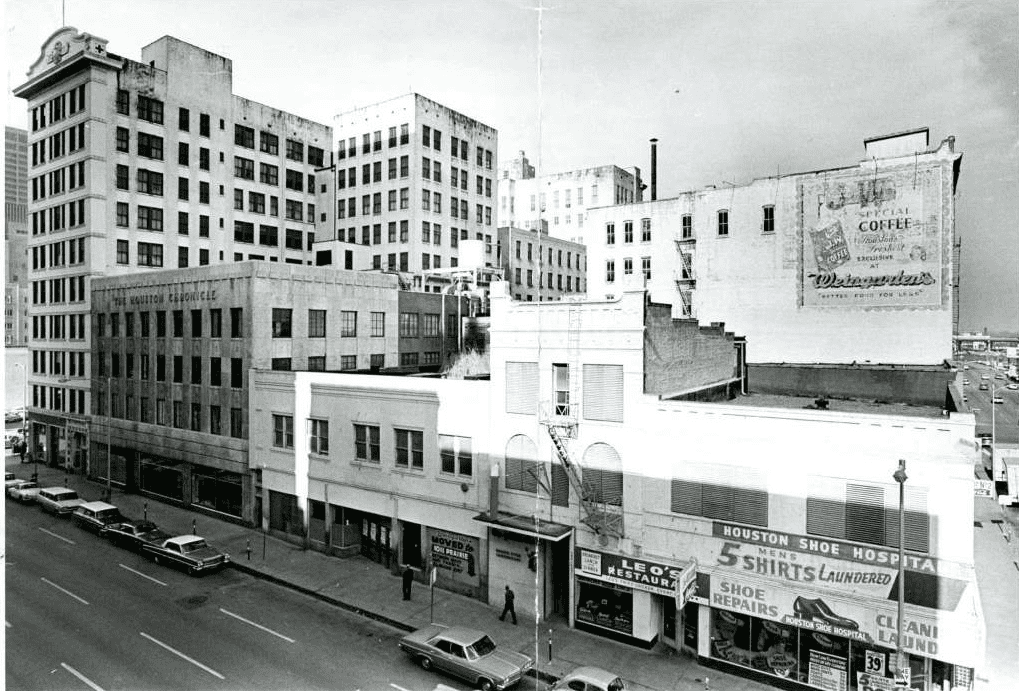
Not everything went smoothly. In 1922, the Ku Klux Klan raised its hooded head. The vast majority of officials and influential people in Harris County were its members. The city was in turmoil. The Houston Chronicle immediately began to condemn this shameful act. Foster personally wrote several angry articles condemning the actions of the Ku Klux Klan. This negatively reflected on the newspaper. The powerful people did their best to destroy the newspaper. Almost all the employees of the publication begged the boss to reduce the attacks. However, Foster remained categorical and loyal to his beliefs. He said: ‘Before I do that, I’ll take the printing equipment apart and throw it in pieces into Buffalo Bayou’. The newspaper’s steadfast position and its popularity far beyond Texas helped it survive these difficult times.
The next crisis came in 1987. Then, laws were passed restricting commercial newspapers. The owners were forced to sell the newspaper to the Hearst Corporation. The print media was paid a record sum of $415 million. It remains the highest ever paid sum for an American newspaper.
With the advent of the Internet, print publications began to gradually fade into the background. However, the Houston Chronicle did not give up. It actively switched to the digital media format and continues to delight ordinary Houstonians with its unbiased views on the present.
The Houston Post: a recognized leader, journalistic acumen and innovative printing
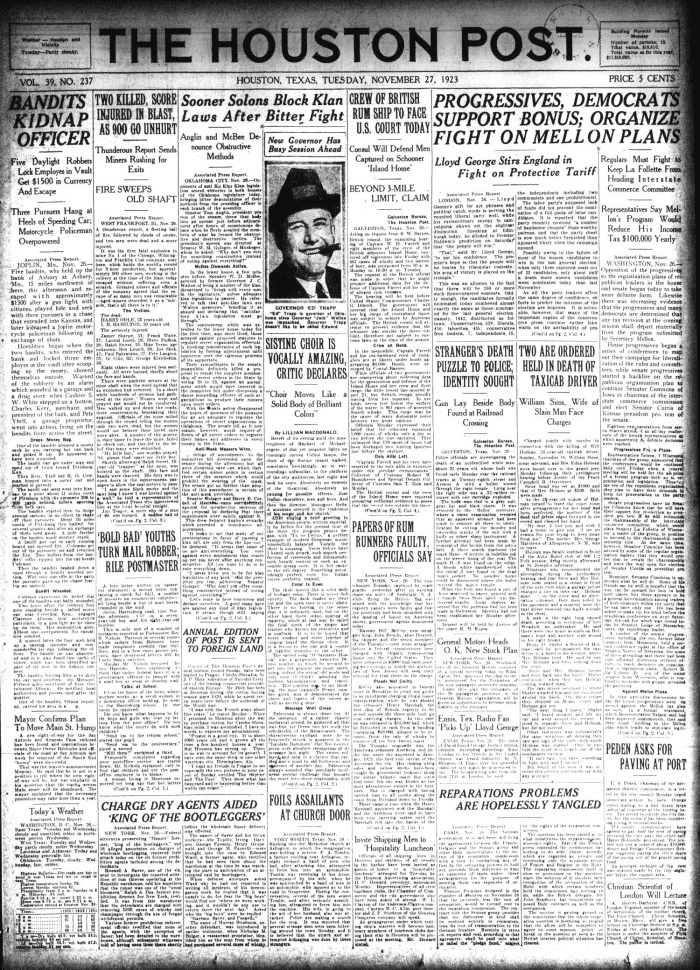
The newspaper had several predecessors with the Post part of the names. However, none of them achieved either public recognition or commercial success. The official founding date was in 1886. The Houston Printing Company was reorganized into a joint-stock company and began printing the independent newspaper Daily Post. The publication quickly gained readership and became one of the leading daily newspapers in Texas.
The editor-in-chief of the print media from the beginning was the future US Senator Rienzi M. Johnston. At the dawn of its existence, the newspaper was published on 8 pages. From 1903, the publication offered the reader 12 pages. The Houston Post started with small circulations, reaching 6 thousand copies by the end of the 19th century. In 1901, the newspaper’s circulation grew to 14 thousand copies. The annual subscription fee has long been unchanged and comprised $8. The newspaper has steadfastly supported and continues to support the Democratic Party.
The publication owes its success to the skillful actions of the editor-in-chief, who successfully selected employees. Historians claim that after Johnston read an article in some little-known newspaper, he immediately went to the editorial office of this media to lure this reporter to him. He succeeded.
The Houston Post had its own unique style, inherent only to this publication. In addition to the daily column of the editor-in-chief, with which most people began their reading, there were such obligatory interesting columns as Tales of the City, Some Postscripts and others. An interesting innovation of the newspaper was the introduction of the column Greater Houston. Contributions to this section could be published by any of the townspeople. Usually, they were local public leaders and businessmen.
This print media was the first in the region and the third in the United States to use the Mergenthaler linotype machine for printing. In 1995, the newspaper ceased to exist due to financial difficulties and the transition of the media to the digital mode.
The Houston Defender: the voice of the voiceless, a family affair and the solid opinions
The beginning of the 1930s was one of the most difficult for America due to the Great Depression, racial intolerance and global unemployment. The apogee of the cruelty of racism falls precisely at this time. Then, the largest print publication for black people, The Houston Defender, was launched. The newspaper was founded by Clifton F. Richardson Sr.
Those who knew Richardson described him as courageous, militant and ready to respond to the problems of black residents of Houston. He fought against the deprivation of black rights and was not afraid to condemn white people. He and his family were repeatedly threatened and the office of the publication was robbed. However, nothing could shake Richardson’s convictions.
The newspaper, published by Clifton F. Richardson, had a small circulation. Still, it was a huge success among black residents of Houston. The publication became known for publications that called for democracy and interracial cooperation, even before the advent of desegregation.
Later, the powers of editor-in-chief were taken over by Richardson’s son. He continued his father’s tradition of fighting for equal rights and a just society. The newspaper existed until 1981. Then, it was sold to the Sonceria ‘Sonny’ Messiah Jiles company.

Anachronism or transformation?
With the transition to digital media, many Houston newspapers ceased their existence, some have adapted to the new requirements of the time and changed their format, switching to online versions. Still, some of the most successful among them continue to print paper copies. This is more of a tradition and respect for the older generation of readers who remain faithful to their favorite publications.